



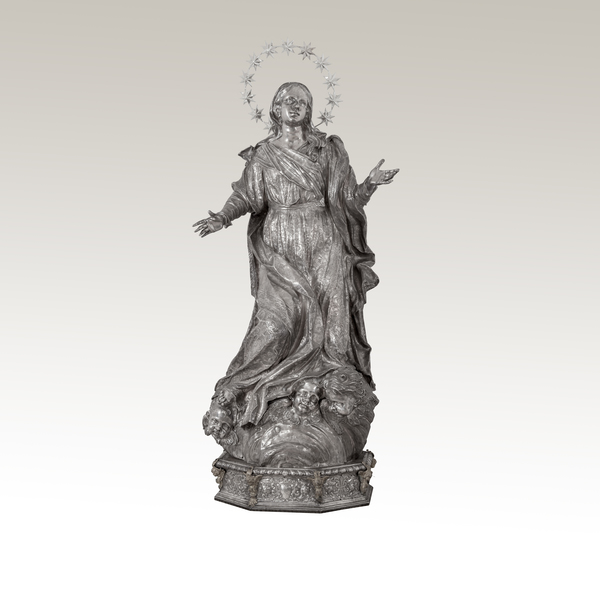
| Scheda | 54 |
| Nome immagine | mudima_54.jpg |
| Materiale | Argento sbalzato e cesellato |
| Autore | Biagio Guariniello |
| Datazione | 1698 |
| Provenienza | Aule capitolari della Cattedrale di Altamura |
| Punzoni | NAP coronato 98 |
| Bibliografia | Santoro 1959, p. 31; E. e C. Catello (Argenti napoletani dal XVI al XIX secolo) 1973, p. 140; E. Catello in Seicento napoletano 1984, pp. 359-361. |
Madonna Assunta in cielo
La magnifica scultura raffigurante l’Assunta, tuttora portata in processione durante la festa patronale del 15 agosto, fu commissionata dal Capitolo della cattedrale a uno dei più importanti maestri argentieri della città partenopea: Biagio Guariniello. La paternità dell’opera è confermata da una ricca documentazione presente nei registri di amministrazione della maior ecclesia altamurana che attesta, tra le altre cose, anche il costo complessivo dell’opera – 6138 ducati e 94 grana – e l’arrivo nella città murgiana il 16 agosto 1698 (ASDA, Registro Assunta n. 154, 1698-1711, f. 271 r). Un'altra testimonianza scritta rivela invece, che, proprio per la sua importanza e per l’alto costo della realizzazione, l’Assunta sia stata valutata prima di essere consegnata da alcuni periti che furono gli argentieri Francesco d’Angelo e Antonio Avitabile per parte di Guariniello e Nicola d’Aula e Giacomo Antonio Parascandolo per conto del Capitolo (cfr. Catello 1987, p. 587); i periti accertarono il peso della Madonna in 137 libbre e 4 once di argento (ASDA, Registro Assunta n. 154, 1698-1711, f. 374 bis). Tuttavia, se la documentazione inequivocabilmente riconduce la scultura alla mano dell’argentiere napoletano, l’utilizzo dei punzoni BV – che tra l’altro sono presenti anche sul paliotto d’argento della cripta della catterale di Acquaviva delle Fonti, realizzato dallo stesso Guariniello nel 1692 (E. Catello in Seicento napoletano 1984, p. 361) – pone un grosso interrogativo sulla reale paternità dell’opera, tanto da far ipotizzare a Elio Catello che la stessa fosse stata appaltata all’argentiere napoletano e realizzata da un suo socio di bottega (E. Catello in Seicento napoletano 1984, p. 361). Queste congetture non tolgono fascino ed eccezionalità alla statua dell’Assunta il cui corpo è costruito con una magnifica e solida veste finemente cesellata a piccoli motivi floreali, poggia i piedi con leggiadria su una coltre con vispi puttini, mentre apre le braccia e solleva lievemente il suo viso sorridente verso il cielo. Contribuiscono a dare movimento alla composizione la gamba destra della Vergine, leggermente avanzata, e il manto che, grazie al suo moto avvolgente intorno alla veste, sembra quasi dover volare via da un momento all’altro. Guariniello, nonostante gli accenni barocchi nel movimento e nell’eccentricità delle emozioni, realizzò una statua monumentale in piena sintonia con la coeva scultura marmorea e lignea di Lorenzo Vaccaro – di cui il maestro argentiere spesso utilizzava i disegni (E. Catello in Seicento napoletano 1984, p. 361) – in linea con l’ambiente culturale partenopeo di quegli anni (Abbate 2002, pp. 202-203).